

access to community leadership & Representation
measuring community power & engagement
According to the National Library of Medicine,
Community power is not equally distributed
Network analyses used in this study showed that grassroots leaders comprise a self-referential cluster that could benefit from greater affiliation and collaboration with leaders from other sectors. The study also identifies leaders who may serve as leverage points in the overall program of public agenda change to address inequalities, specifically health inequalities.
The analysis suggests that community partners should deepen their relationship with education and media sectors.
Stanford University reports that
As more foundations shift priorities toward building community power, assessing their progress presents a critical challenge.
Short-term grant cycles often do not directly line up with the long-term arc of social change, meaning funding for community power building can’t match the resources of those who wield power. Measurement becomes even more difficult due to limited resources.
These difficulties make it all the more essential for community-based organizations and the foundations that support them to assess progress for reflection, learning, and course correction.
As a simplified way to think about measures of community power, there are three interrelated scales at which grassroots organizations are building power: societal, base, and organizational capacity.
See measurement strategies below
The Association for the Study and Development of Community provides A Guide to Measuring Community Core Capacities for Comprehensive Change Initiatives. The report provides assessment instruments for:
Shared vision
Resident leadership
Strategic partnership
Powerful strategies
Transforming public systems
Learning and use of data
Communication
Governance
Cross-cultural competence
Community capacity building
Conflict transformation
-
The most effective path forward is always shifting with changes in political context. To have an idea of how the particular movement in which you are participating is making progress toward that shared vision, you must measure both visible and invisible impact at the societal scale.
Visible: time-bound campaigns with specific goals are necessary vehicles through which groups build power to achieve their visions and are important indicators of progress in power building at the societal level.
Invisible: A less visible indicator of power is the ability to set and advance an agenda. After successfully stopping the voter ID requirement, the organizations involved in Our Vote Our Future were able to advance multiple bills at the legislature the following year. To measure the ability to set the agenda in the state, the coalition could have tracked the bills introduced during the 2012 legislative session and compared that to the 2013 season (and beyond).
Invisible: Another less visible measure of power at the societal scale is the ability to influence mindsets, underlying assumptions, and culture. These are the tectonic plates of social change. They are slow-moving, large in scale, and foundational for all change efforts, and they make up what is often called the “dominant narrative”
-
The core work of building power in marginalized communities is organizing a constituency base and developing leaders among its members. In the most general sense, this base consists of both the targets of power-building efforts (members of communities that have been historically marginalized) and the agents of these efforts (activists and engaged voters from all backgrounds), with considerable overlap between the two.
The power of this membership base can be measured in a variety of ways. The most common measures of this organizational “people power” are size and diversity of the membership base, number of members taking on leadership roles, and number of grassroots leaders
Beyond measures of size and scale, what matters for the exercise of power in the world are certain attributes of the membership base.
An organization can learn a great deal by tracking who is in its constituency base and what they are doing. In turn, this allows an organization to better understand the independence, commitment, and flexibility of the base. What relationships do people have with each other? Are they repeatedly taking action? Are they accountable to each other? How easily do they pivot as the terrain they are operating on shifts?
-
Organizational structure and capacities are too often seen as separate from power building efforts, but design choices internal to an organization aka collective capabilities, are essential to a constituency base’s ability to wield power
Given the importance of these design choices to building power, funders, and community-power organizations should consider an organization’s progress in building these capacities when assessing power-building efforts.
Does the organization have transparent decision-making processes that ensure accountability to the constituency base?
Have the organization’s leaders developed strategies to integrate learning into their daily routines and then apply what they’ve learned?
Do they build space into people’s work plans to allow for flexibility in times of change?
Organizations should identify the capacities in greatest need of development and then invite a range of people, including staff and members, to assess these capacities and the organization’s progress in building them. The organization can then use this data to identify what has led to their success, identify opportunities for additional growth, and track their progress in building these capacities.
This review concludes:
Rather than funding a third-party evaluator that reports to you, you should support organizations with the resources to develop their own capacity.
“When grantees develop approaches to measure their progress in building power, we encourage you to walk alongside them, understand your own power, and make choices to be in mutual support and relationship with those who have the most to gain in the struggle for equity, sustainability, and justice.”

assessing community power & engagement
-
Define what should be measured in meaningful community engagement, not what is currently measured
Be sufficiently flexible to measure engagement in any community
Define health holistically
Allow the community to see itself in or identify with the language, definitions, and context
Embed equity throughout the model
Emphasize outcomes of meaningful community engagement
Present a range of outcome options for various stakeholders
Communicate the dynamic and transformative nature of engagement
-
Diversity and inclusivity
Partnerships and opportunities
Acknowledgement, visibility, recognition
Sustained relationships
Mutual value
Trust
Shared power
Structural supports for community engagement
-
New curricula, strategies, and tools
Bidirectional learning
Community-ready information
-
Community-aligned solutions
Actionable, implemented, and recognized solutions
Sustainable solutions
-
Physical and mental health
Community capacity and connectivity
Community power
Community resiliency
Life quality and well-being
National Library of Medicine - Assessing meaningful community engagement
People and the communities they are a part of are deeply impacted by the systems that drive and influence their health; however, they are often not included in the process to create or restructure programs and policies designed to benefit them.
When local policies and programs are not driven by community interests, concerns, assets, and needs, these efforts remain disconnected from the people they intend to serve. This disconnect limits the influence and effectiveness of interventions, policies, and programs.
True, meaningful community engagement requires working collaboratively with and through those who share similar situations, concerns, or challenges. Citizens’ engagement serves as “a powerful vehicle for bringing about environmental and behavioral changes that will improve the health of the community and its members”.
This process involves partnerships, coalitions, and community relationships.
It is important to note that meaningful community engagement requires working closely with communities to understand their preferences on how, when, and to what level and degree they want to be engaged in efforts.
National Academy of Medicine Conceptual Model
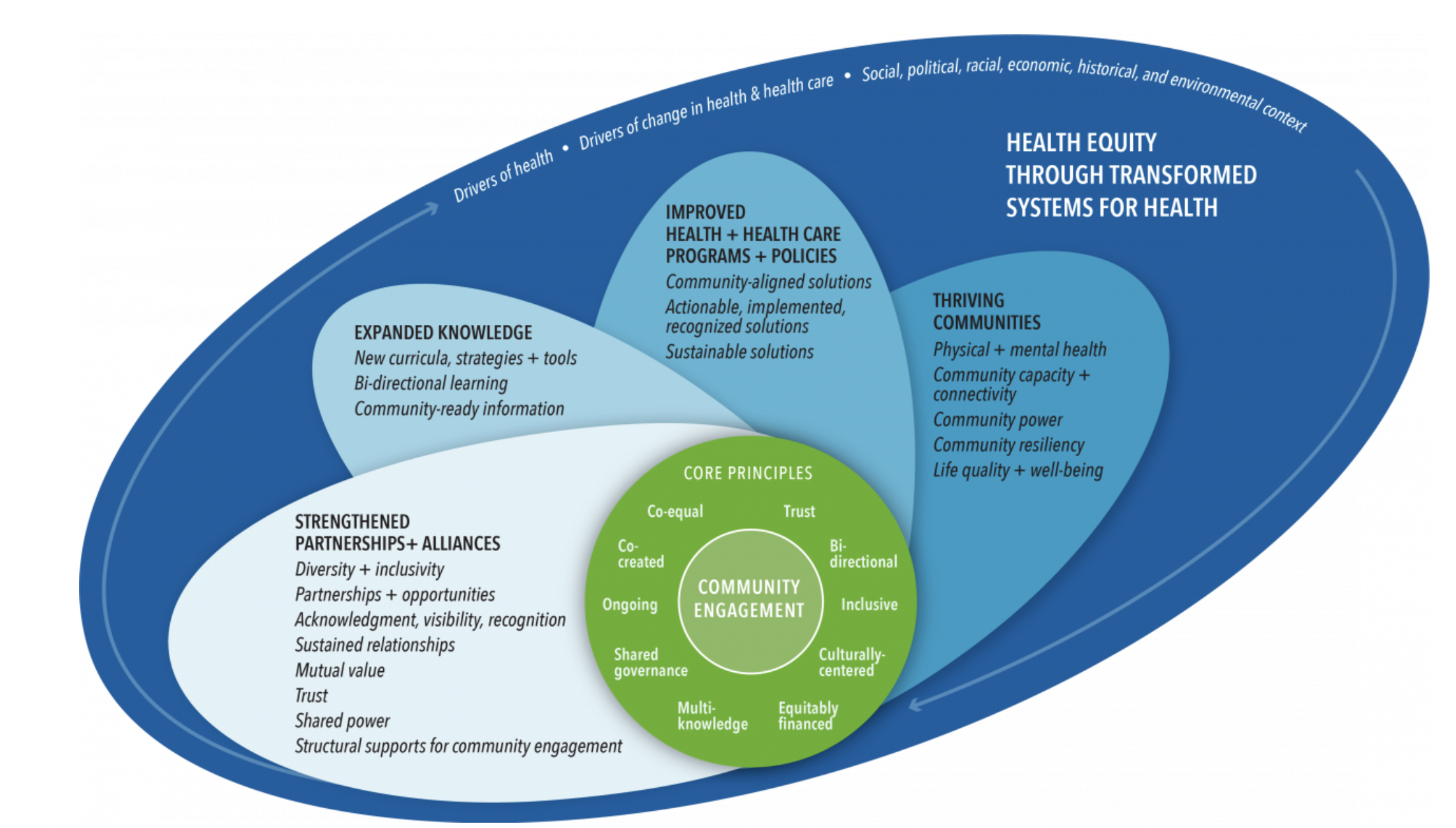

The National Academy of Medicine’s Assessment Instruments for Measuring Community Engagement identifies 28 instruments to support assessing community engagement. Instruments are questions or question sets used to consistently assess community engagement.
Instrument summaries include:
An overview of the Instrument, which audiences use it, and what it assesses
How the Instrument and the questions align with the Assessing Community Engagement Conceptual Model
Highlights from articles and reports on the development and use of the Instrument, how the community was engaged in the process, and key findings
Information on language translations, psychometric properties, and more
Within this source you can:
Explore each instrument
Learn how to navigate the instruments
Utilize tools on developing a plan for assessing community engagement
Explore resources